Article: When Should You Take Pre-Workout? Timing, Empty Stomach and Evening Training
When Should You Take Pre-Workout? Timing, Empty Stomach and Evening Training
Quick answer: Take a caffeinated pre-workout about 20–30 minutes before training if you have not eaten much, or closer to 45–60 minutes before if you have just had a meal, because food slows how quickly caffeine peaks in the blood. Caffeine has an average half-life of about four hours, so give yourself as long as possible before bed: research shows caffeine taken six hours before bed still disrupts sleep. If you train in the evening, a stim-free formula is the safer choice.
How long does pre-workout take to kick in?
Caffeine is absorbed quickly and almost completely. EFSA says its stimulant effects may begin 15–30 minutes after you take it and last a number of hours. The International Society of Sports Nutrition (ISSN) caffeine position stand reports that blood levels peak anywhere from 30 to 120 minutes after an oral dose, and that the most common timing used in research is 60 minutes before exercise.
| Time after taking | What is happening |
|---|---|
| 15–30 minutes | Stimulant effects may begin (EFSA) |
| 30–120 minutes | Caffeine peaks in the blood, depending on the person, the form and what you have eaten (ISSN) |
| About 4 hours | Average half-life in healthy adults, with a range of 2–8 hours (EFSA) |
| About 8 hours | Around a quarter is still in your system on an average half-life: roughly 90mg from a 362.5mg serving |
Half-life is the time your body takes to clear half of a substance. Example: with a four-hour half-life, 300mg at 2pm becomes about 150mg by 6pm and 75mg by 10pm.
Best timing for your training slot
| Your situation | When to take it | Why |
|---|---|---|
| Early morning, nothing eaten | 20–30 minutes before | Caffeine peaks faster when you have not eaten |
| Within an hour of a meal | 45–60 minutes before | A large carbohydrate meal delayed the caffeine peak to 2–3 hours in one study |
| Lunchtime or early afternoon | 20–45 minutes before | Still leaves plenty of time before bed |
| Evening, in bed within about 8 hours | Switch to stim-free | Caffeine six hours before bed still cut sleep in research |
| Training twice in one day | Caffeine for one session only | Keep to one caffeinated serving in 24 hours; use stim-free for the other |
Should you take pre-workout on an empty stomach?
It works either way, but food changes how the caffeine arrives. In a 2013 crossover trial, caffeine peaked in the blood 60 minutes after it was taken when participants were fasted, but 120–180 minutes after when they had eaten a high-carbohydrate meal first, and the peak was lower.
- Empty stomach. Pros: faster, sharper onset. Cons: some people find high-caffeine products sit badly without food, and you have less fuel for a long session.
- Light meal 1–2 hours before. Pros: fuel for training and a steadier onset. Cons: very little; this suits most people. Our usage guidance for PRE V4 suggests 30–60g of carbohydrate around 60 minutes before training, plus plenty of water.
- Large meal right before. Pros: none for timing. Cons: a slower, lower caffeine peak, and you may feel heavy under the bar.
Rule of thumb: eat a light, carbohydrate-based meal one to two hours out, then take your pre-workout 20–30 minutes before your first working set.
Timing for the other ingredients
Not everything in a pre-workout works on the clock.
- Citrulline: studies on citrulline malate typically gave 6–8g 40–60 minutes before training. A 2021 meta-analysis found this increased repetitions to failure by about 6% on average, a small effect.
- Beta-alanine: builds up carnosine in muscle over weeks, so daily intake matters more than the minute you take it. The ISSN says 4–6g a day for at least 2–4 weeks has been shown to improve exercise performance. Its only reported side effect is tingling (paraesthesia), which smaller, split doses reduce.
Carnosine is a compound stored in muscle that acts as a buffer against acid build-up during hard efforts. Example: high-rep sets lasting a minute or more, where acid builds up in the working muscle.
Training in the evening: pre-workout and sleep
This is where timing matters most. The evidence:
- In a 2013 study, 400mg of caffeine taken six hours before bed reduced objectively measured sleep by more than an hour, even though participants did not report noticing it.
- A 2023 meta-analysis of 24 studies found caffeine cut total sleep time by 45 minutes, added 9 minutes to the time taken to fall asleep and reduced deep sleep. It calculated that a standard pre-workout serve (217.5mg) should be taken at least 13.2 hours before bed to avoid losing sleep.
- The ISSN describes a study where caffeine taken at 18:00 caused insomnia in six participants, compared with one participant after morning intake.
Responses vary a lot, and the ISSN links some of that variation to genetics. But if you train at 6pm and go to bed at 11pm, a full caffeinated scoop is working against your sleep. Your options:
- Move caffeinated sessions earlier in the day.
- Use a smaller caffeine dose, taken as early as you can.
- Switch to a stim-free formula for evening sessions.
See how much caffeine is in pre-workout for safe daily totals, and pre-workout vs pump formula for choosing a stim-free option.
How DARKSTIMS products fit
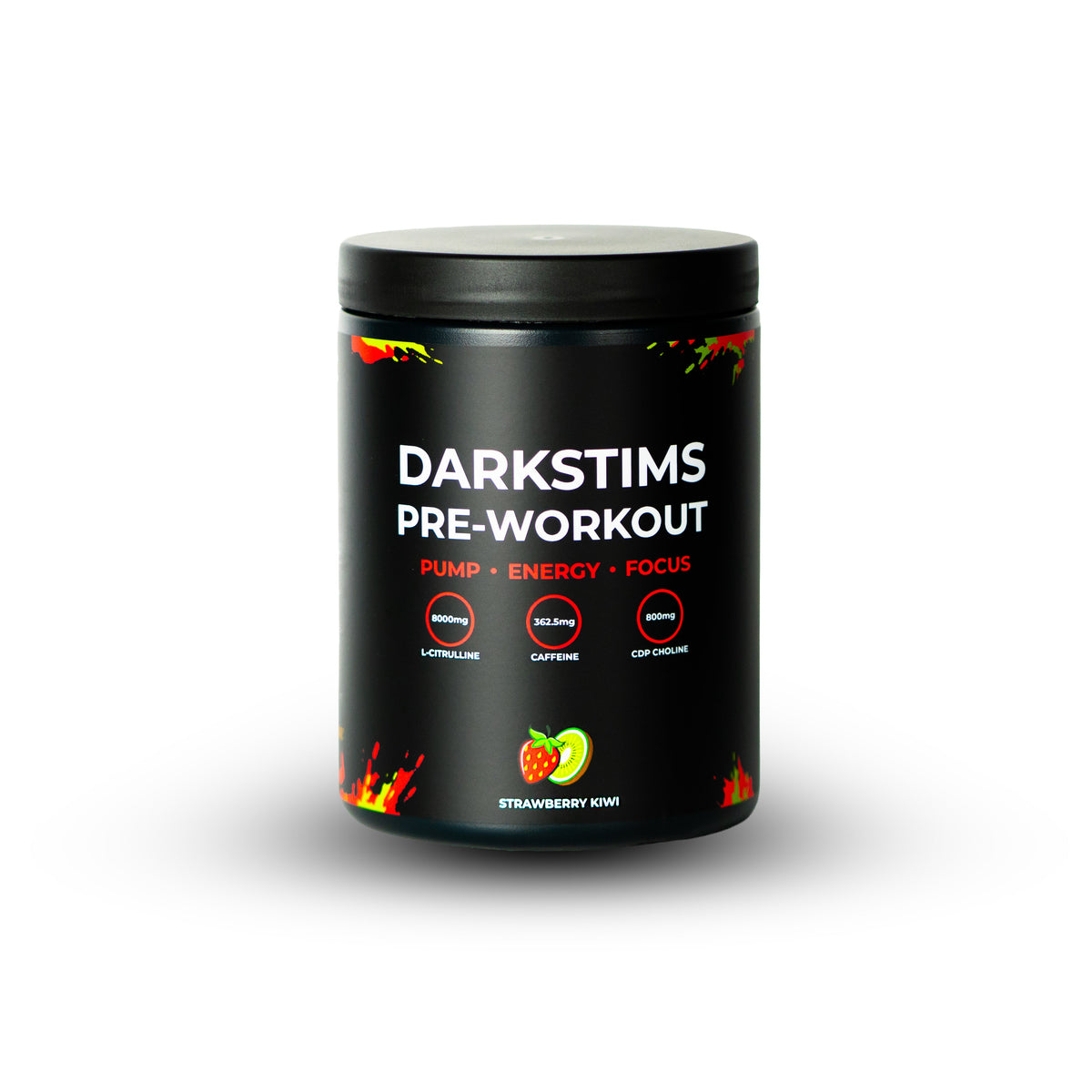
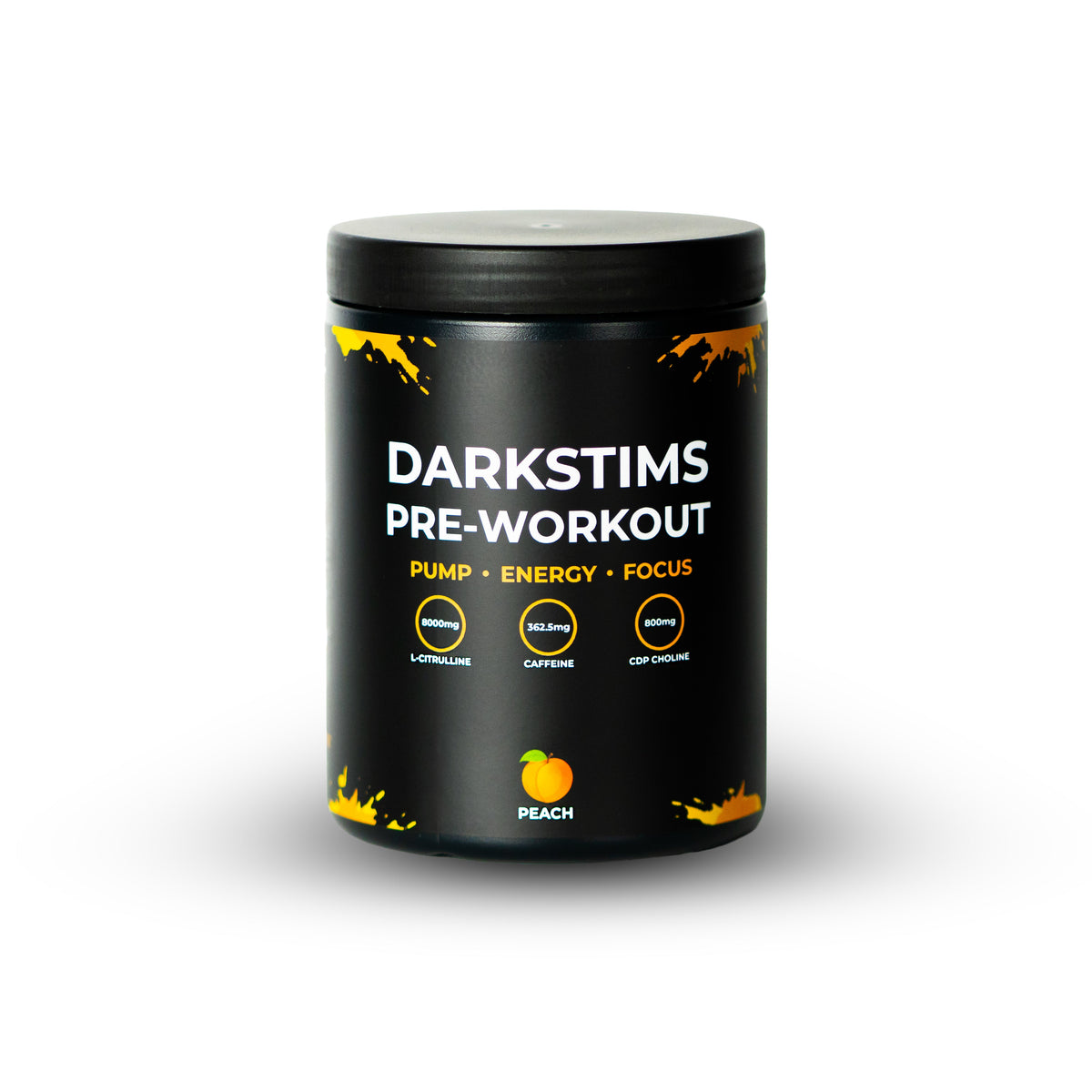
- DARKSTIMS PRE V4: 362.5mg caffeine per serving (from a 400mg dual-source caffeine matrix). Label directions: one 20g scoop in 400–600ml cold water 20–30 minutes before training; half a scoop the first time; never more than one serving in 24 hours. Best kept to morning and early-afternoon sessions.
- DARKSTIMS ULTRA V2: 500mg caffeine per 30g serving. One scoop in 600–800ml cold water, for occasional use only by healthy adults 18+ used to high caffeine; half a scoop the first time; never with other caffeine.
- DARKSTIMS PUMP V2: 0mg caffeine, the stim-free option for evening sessions or a second session.
- DARKSTIMS Caffeine Electrolytes: 150mg natural caffeine, a lower-caffeine option for mornings or around training. DARKSTIMS Electrolytes is caffeine-free.
FAQ
Should I take pre-workout 30 or 60 minutes before training?
Either can work. 20–30 minutes suits a light stomach and matches the PRE V4 label. 60 minutes matches the most common timing in caffeine research and suits you better if you have eaten recently. Always follow the directions on your product.
Can I take pre-workout on an empty stomach?
Yes, if you tolerate it. Caffeine tends to peak faster without food. If you feel jittery or queasy, use half a serving or have a light carbohydrate snack first.
What time is too late for pre-workout?
There is no single cut-off because people clear caffeine at very different rates. Research shows 400mg six hours before bed still disrupts sleep, and a 2023 meta-analysis suggests 13.2 hours for a 217.5mg serve. As a minimum, avoid caffeinated pre-workout within six to eight hours of bed and use a stim-free formula after that.
Can I take pre-workout twice if I train twice a day?
Not a caffeinated one. Keep to one caffeinated serving in 24 hours and keep your total daily caffeine within 400mg from all sources. Use a stim-free formula for the second session.
Sources
- EFSA (2015). EFSA explains risk assessment: Caffeine (summary of the Scientific Opinion on the safety of caffeine)
- Guest NS et al. (2021). International Society of Sports Nutrition position stand: caffeine and exercise performance. JISSN
- Skinner TL et al. (2013). Influence of carbohydrate on serum caffeine concentrations following caffeine ingestion. Journal of Science and Medicine in Sport
- Drake C et al. (2013). Caffeine effects on sleep taken 0, 3, or 6 hours before going to bed. Journal of Clinical Sleep Medicine
- Gardiner C et al. (2023). The effect of caffeine on subsequent sleep: a systematic review and meta-analysis. Sleep Medicine Reviews
- Trexler ET et al. (2015). International Society of Sports Nutrition position stand: beta-alanine. JISSN
- Vårvik FT et al. (2021). Acute effect of citrulline malate on repetition performance during strength training: a systematic review and meta-analysis. IJSNEM
DARKSTIMS products are food supplements and should not be used as a substitute for a varied, balanced diet and a healthy lifestyle. Do not exceed the stated serving. Speak to your GP before use if you are pregnant, breastfeeding, under 18, taking medication or have a medical condition. Caffeinated products are not suitable for children, pregnant or breastfeeding women, or anyone sensitive to caffeine; count caffeine from all sources and do not combine caffeinated products.