How Much Caffeine Is in Pre-Workout, and How Much Is Too Much?
Quick answer: There is no standard amount: pre-workouts tested in research have contained roughly 60mg to 375mg of caffeine per serving, and high-stimulant products go higher. The European Food Safety Authority (EFSA) says single doses up to 200mg, and up to 400mg a day from all sources, raise no safety concerns for healthy adults (up to 200mg a day if pregnant or breastfeeding). For most healthy adults, "too much" means going past 400mg in a day from all sources, or taking a bigger single dose than your body is used to.
How much caffeine is in a typical pre-workout?
Doses vary widely. A 2018 review of multi-ingredient pre-workout supplements covered studied products containing from about 60mg to about 375mg of caffeine per serving, and pointed out that many labels hide exact doses inside proprietary blends. A 2023 meta-analysis on caffeine and sleep used 217.5mg as a "standard serve" of pre-workout. High-stimulant products, including two of ours, sit well above that.
It helps to compare pre-workout with what you already drink. Everyday figures below are NHS estimates.
| Source | Caffeine (approx.) |
|---|---|
| Can of cola | 40mg |
| Cup of tea | 75mg |
| 250ml can of energy drink | 80mg |
| Cup of instant coffee (filter and coffee-shop coffee can contain more) | 100mg |
| "Standard serve" of pre-workout used in a 2023 meta-analysis | 217.5mg |
| DARKSTIMS PUMP V2 (stim-free) | 0mg |
| DARKSTIMS Caffeine Electrolytes | 150mg |
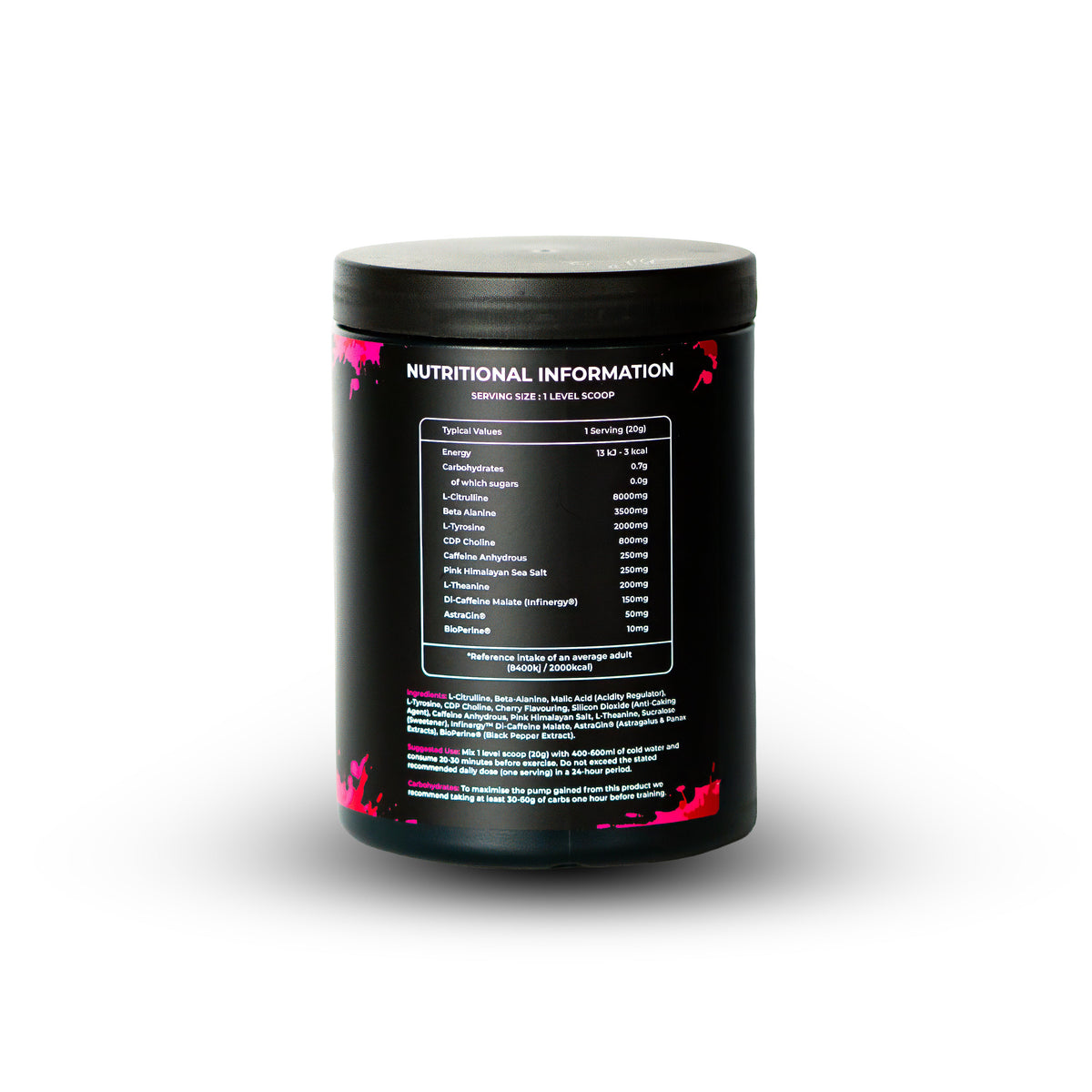
| DARKSTIMS PRE V4 | 362.5mg |
| DARKSTIMS ULTRA V2 | 500mg |
What the safety guidance says
The key reference point in the UK and Europe is EFSA's 2015 Scientific Opinion on the safety of caffeine. Its main conclusions:
- Single dose: up to 200mg (about 3mg per kg of body weight) from all sources raises no safety concerns for healthy adults, including when taken less than two hours before intense exercise in normal conditions.
- Daily total: up to 400mg a day (about 5.7mg/kg), spread through the day, raises no safety concerns for healthy adults, except pregnant women.
- Pregnant and breastfeeding women: up to 200mg a day. The NHS gives the same 200mg daily limit for pregnancy.
- Sleep: single doses of 100mg may affect sleep in some adults, particularly close to bedtime.
Two points people miss. First, the 400mg is from all sources: tea, coffee, energy drinks, gum and supplements added together. Second, the 200mg figure is per dose, so a 300mg+ scoop is above it even if your daily total is fine. That is why higher-caffeine pre-workouts are only for healthy adults who already know how they react to caffeine.
How much caffeine actually helps performance?
The International Society of Sports Nutrition (ISSN) position stand concludes that caffeine consistently improves exercise performance at 3–6mg per kg of body mass. The minimum effective dose may be as low as 2mg/kg, while very high doses (around 9mg/kg) bring a high rate of side effects and do not seem to be needed for a benefit.
mg/kg means milligrams of caffeine per kilogram of body weight. Example: an 80kg lifter taking 3mg/kg has 240mg.
| Body weight | 3mg/kg | 6mg/kg |
|---|---|---|
| 60kg | 180mg | 360mg |
| 70kg | 210mg | 420mg |
| 80kg | 240mg | 480mg |
| 90kg | 270mg | 540mg |
Notice that the top of the research range can exceed EFSA's figures. Research doses show what produced an effect in a study; they do not override safety guidance. The sensible starting point is the lower end of the range, with your whole day's caffeine kept within 400mg.
Signs you have taken too much
The ISSN lists the most commonly reported side effects as a fast heart rate, palpitations, anxiety, headaches and poor sleep, and notes they rise with the dose. Simple rules keep you clear of them:
- Never take more than one serving in 24 hours, and never double-scoop.
- Count every source. A 362.5mg pre-workout plus two instant coffees is over 550mg.
- Do not combine a pre-workout with energy drinks, caffeine tablets or another caffeinated supplement.
- The first time you use any product, start with half a serving.
- Stop and get medical advice if you have chest pain, palpitations that do not settle, or feel faint.
Caffeine tolerance: do you need more over time?
Tolerance is real but gradual. In a 2019 trial, people taking 3mg/kg of caffeine every day kept a performance benefit for around 15–18 days, but the size of that benefit shrank progressively. The ISSN notes that research on habitual caffeine users is mixed, with some studies showing regular coffee drinkers still benefit.
The practical takeaway: do not chase the feeling with bigger scoops. Keep your highest-caffeine product for your hardest sessions, and use lower-caffeine or stim-free options on the other days.
Caffeine and sleep: when to stop
EFSA puts the average half-life of caffeine in healthy adults at about four hours, with a range of two to eight. Half-life is the time your body takes to clear half of it. Example: 362.5mg at 6pm still leaves about 180mg in your system at 10pm on an average half-life.
- A 2013 study found that 400mg of caffeine taken six hours before bed still significantly disrupted sleep.
- A 2023 meta-analysis of 24 studies found caffeine cut total sleep time by 45 minutes on average, and calculated that a standard pre-workout serve (217.5mg) should be taken at least 13.2 hours before bed to avoid losing sleep.
For most people, that makes a caffeinated pre-workout a morning or early-afternoon tool. If you train after work and go to bed within six to eight hours, stim-free is the better choice. Our guide on when to take pre-workout covers timing in more detail.
Stim-free options
Stim-free means no caffeine or other stimulants. Stim-free formulas are usually built around ingredients such as L-citrulline, beta-alanine and betaine. You lose the caffeine lift, but you avoid adding to your daily caffeine total or affecting sleep. For a full comparison, read pre-workout vs pump formula.
Where DARKSTIMS products fit
Every DARKSTIMS label shows each ingredient and its dose. Caffeine per serving:
- DARKSTIMS PRE V4: 362.5mg caffeine per serving (from a 400mg dual-source caffeine matrix: 250mg caffeine anhydrous and 150mg Infinergy di-caffeine malate). This is above EFSA's 200mg single-dose figure, so it is for experienced, healthy adults. First time, use half a scoop (about 181mg).
- DARKSTIMS ULTRA V2: 500mg caffeine per 30g serving, above both EFSA figures on its own. For healthy adults 18+ already used to high-caffeine products only, for occasional use, never with any other caffeine. First time, use half a scoop (250mg).
- DARKSTIMS Caffeine Electrolytes: 150mg natural caffeine per serving, below the 200mg single-dose figure.
- DARKSTIMS PUMP V2: 0mg caffeine. DARKSTIMS Electrolytes is also caffeine-free.
FAQ
Is 300mg of caffeine in a pre-workout too much?
For a healthy adult used to caffeine, 300mg in one dose is above EFSA's 200mg single-dose figure but within its 400mg daily figure, as long as the pre-workout is most of your caffeine that day. If you are new to caffeine or lighter than about 60kg, start with a smaller dose.
Can I drink coffee on the same day as my pre-workout?
Only if your total stays within 400mg. A 362.5mg serving leaves under 40mg of headroom, which is less than a cup of tea, so on those days skip the coffee. A lower-caffeine product gives you more room.
How long does pre-workout caffeine last?
EFSA says caffeine's effects may begin 15–30 minutes after you take it and last a number of hours. With an average half-life of about four hours, a meaningful amount is still in your system six to eight hours later.
Is 500mg of caffeine safe?
500mg in a single serving is above EFSA's single-dose and daily figures for healthy adults. Products at this level are only for healthy adults already used to high caffeine, for occasional use, never combined with other caffeine. They are not for anyone under 18, pregnant or breastfeeding, sensitive to caffeine, or with a heart condition, high blood pressure, anxiety or sleep problems.
Sources
- EFSA (2015). EFSA explains risk assessment: Caffeine (summary of the Scientific Opinion on the safety of caffeine)
- NHS. Foods to avoid in pregnancy (caffeine section)
- Guest NS et al. (2021). International Society of Sports Nutrition position stand: caffeine and exercise performance. JISSN
- Harty PS et al. (2018). Multi-ingredient pre-workout supplements, safety implications, and performance outcomes: a brief review. JISSN
- Lara B et al. (2019). Time course of tolerance to the performance benefits of caffeine. PLoS One
- Drake C et al. (2013). Caffeine effects on sleep taken 0, 3, or 6 hours before going to bed. Journal of Clinical Sleep Medicine
- Gardiner C et al. (2023). The effect of caffeine on subsequent sleep: a systematic review and meta-analysis. Sleep Medicine Reviews
DARKSTIMS products are food supplements and should not be used as a substitute for a varied, balanced diet and a healthy lifestyle. Do not exceed the stated serving. Speak to your GP before use if you are pregnant, breastfeeding, under 18, taking medication or have a medical condition. Caffeinated products are not suitable for children, pregnant or breastfeeding women, or anyone sensitive to caffeine; count caffeine from all sources and do not combine caffeinated products.